

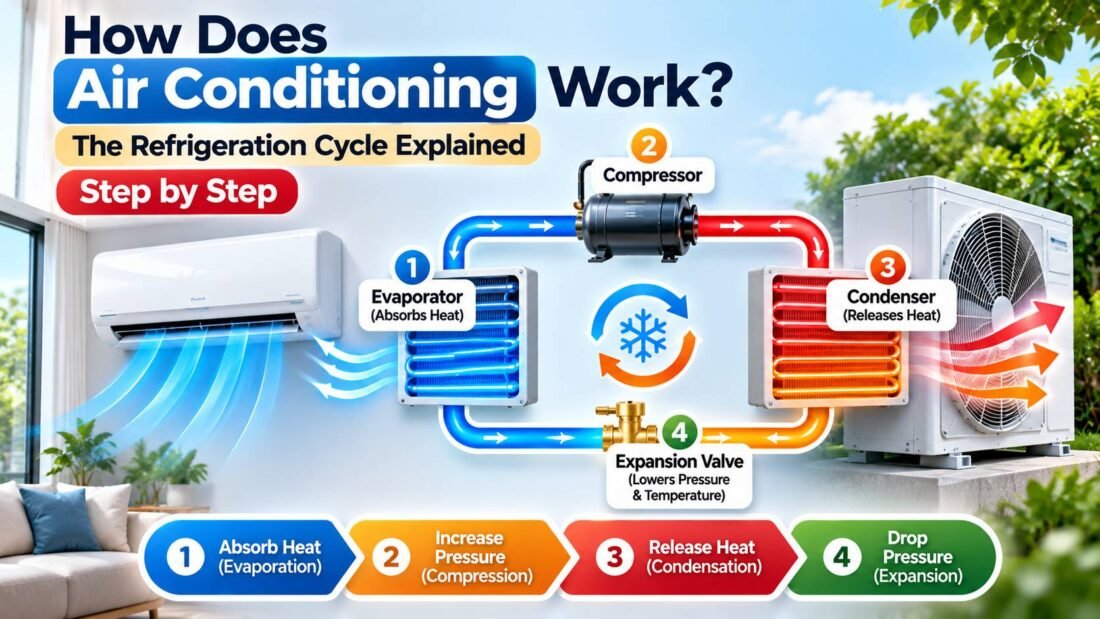
Here’s the part that surprises most people: your air conditioner doesn’t create cold. It removes heat. The cool air coming out of your vents is simply indoor air that had its heat pulled out and carried outside.
Once you understand that one idea, everything else about how air conditioning works falls into place. It also explains why your outdoor unit blows hot air in July, why the indoor coil sweats and why a dirty filter can make your whole system struggle.
First, What Does “AC” Mean?
AC is short for air conditioning. People also write it as “A/C” or “A C.” The term covers any system that cools and dehumidifies indoor air, from a $200 window unit to a 5 ton central system. When someone asks “a c, what does it mean,” they usually just want that simple answer: AC means air conditioning.
How Does Air Conditioning Work? The Short Version
A central air conditioner has two halves connected by copper refrigerant lines. The indoor half absorbs heat from your home. The outdoor half dumps that heat outside. A special fluid called refrigerant carries the heat between them, over and over, in a closed loop.
Refrigerant is useful because it boils at a very low temperature. When it boils inside the indoor coil, it soaks up a lot of heat. When it’s squeezed by the compressor outside, it gets hot enough to release that heat into summer air, even when it’s 95°F out.
The Four Main Parts of an AC System
| Part | Location | Job |
|---|---|---|
| Evaporator coil | Indoors, on the furnace or air handler | Absorbs heat from your indoor air |
| Compressor | Outdoor unit | Pressurizes refrigerant and pumps it through the loop |
| Condenser coil | Outdoor unit | Releases heat to the outdoor air |
| Expansion valve | Indoors, near the evaporator | Drops refrigerant pressure so it gets very cold |
Fans and a blower do the rest. The outdoor fan moves air across the condenser. The indoor blower moves your house air across the evaporator and through the ducts.
The Refrigeration Cycle, Step by Step
Step 1: Warm Air Enters the System
Your thermostat calls for cooling. The indoor blower pulls warm air from your rooms through return vents, through the air filter and across the evaporator coil.
Step 2: The Evaporator Absorbs Heat
Cold liquid refrigerant flows through the evaporator coil at roughly 40°F. As your 78°F house air moves across it, the refrigerant absorbs the heat and boils into a gas. The air leaving the coil is usually 15 to 20 degrees cooler than the air that went in. So 78°F air comes out around 58°F to 60°F.
Step 3: The Compressor Squeezes the Gas
That warm, low pressure gas travels outside to the compressor. The compressor squeezes it into a much smaller space. Squeezing a gas raises its temperature, so the refrigerant may leave the compressor at 150°F or more.
Step 4: The Condenser Releases Heat
The hot gas moves into the condenser coil. The big fan on top pulls outdoor air across the coil. Because the refrigerant is hotter than the outside air, heat flows out of it. As it cools, the refrigerant turns back into a liquid. That’s why the air blowing off your outdoor unit feels hot.
Step 5: The Expansion Valve Drops the Pressure
The warm liquid travels back inside through the smaller copper line. At the expansion valve, the pressure drops suddenly. A drop in pressure makes the refrigerant get very cold again, ready to absorb more heat. The cycle repeats until your thermostat is satisfied.
Why Your AC Also Removes Humidity
When warm, moist air hits the cold evaporator coil, water condenses on it, just like a glass of iced tea sweating on a porch. That water drips into a pan and drains away through a condensate line. On a muggy day in Florida or Louisiana, a central system can pull several gallons of water out of the air.
That’s why a properly running AC makes a room feel more comfortable at 76°F than a dry room might at the same temperature. It’s also why a clogged condensate drain can cause water damage near your furnace.
What a “Ton” of Air Conditioning Means
AC capacity is measured in tons, which has nothing to do with weight. One ton equals 12,000 BTUs of heat removed per hour. A 3 ton system removes 36,000 BTUs per hour. Most American homes use somewhere between 1.5 and 5 tons, depending on square footage, insulation, windows and climate.
How Other Types of AC Work
- Window units put all four parts in one box. The cold side faces the room, and the hot side hangs outside.
- Ductless mini splits use the same cycle, but each room gets its own wall mounted indoor unit instead of ducts.
- Heat pumps run the cycle in both directions. A reversing valve lets them pull heat from outdoor air in winter and bring it inside.
- Packaged units keep everything in one outdoor cabinet and connect to the ducts through a wall or roof.
What Hurts Air Conditioner Performance
Because AC depends on moving air and moving heat, anything that blocks either one makes it work harder:
- Dirty filters. ENERGY STAR notes that airflow problems can reduce a system’s efficiency by up to 15 percent.
- Dirty coils. Dust on the evaporator or grass clippings on the condenser act like a blanket.
- Low refrigerant. This always means a leak. Refrigerant isn’t used up like gas in a car.
- Crowded outdoor unit. Bushes and fences closer than 2 feet choke airflow.
- Wrong size. An oversized unit cools too fast and leaves the air clammy. An undersized one runs nonstop.
How Old Is Too Old?
Efficiency standards have climbed a lot. According to the ENERGY STAR cooling fact sheet, replacing a central AC unit over 12 years old with an ENERGY STAR model could cut cooling costs by about 30%. If your system is from 2012 or earlier and you’re paying $200 a month to cool your home in summer, that’s real money.
The Takeaway
So how does air conditioning work? It moves heat. Refrigerant picks it up inside, the compressor concentrates it, and the condenser throws it outside. Keep the air moving and the coils clean, and that simple cycle will keep your home cool for 15 years or more.
Published by HVAC Daily NEWS.
Frequently Asked Questions
Does an air conditioner bring in outside air?
No. A central AC recirculates the air already inside your home. It moves heat outside but does not pull fresh outdoor air in.
Why does my outdoor AC unit blow hot air?
That's normal. The outdoor unit releases the heat removed from your home, so the air coming off the condenser fan should feel warm.
How cold should air from the vents be?
Supply air is usually 15 to 20 degrees cooler than the return air. If your house is 76°F, vent air around 56°F to 61°F is typical.
Does AC use more electricity than heating?
It depends on climate and fuel. In hot Southern states AC often costs more, while in cold Northern states heating usually costs more.
What does AC mean on a thermostat?
AC on a thermostat means air conditioning. Setting it to Cool or AC tells the system to run the outdoor unit and remove heat.
Why is water dripping near my indoor AC unit?
Your AC removes moisture from air. If the drain line clogs, that water backs up. Clear the line or call a technician quickly.