
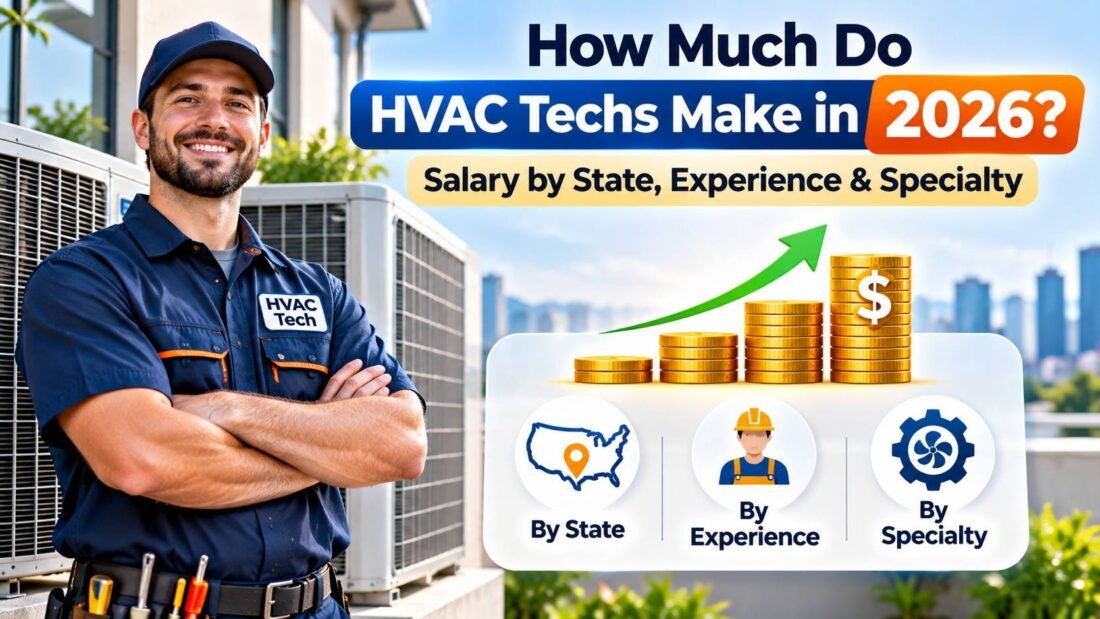
If you’re thinking about getting into the trade, or you’re already in it and wondering whether you’re underpaid, the first question is simple: how much do HVAC techs make?
The short answer: the typical HVAC technician in the U.S. earns about $61,000 a year. But that number hides a huge range. A first year apprentice in a rural town might clear $38,000. A senior commercial tech with overtime in a big metro area can top $100,000. This guide breaks down where that money comes from and how to move up the scale.
The Official Numbers
The most reliable source on HVAC wages is the federal government’s Bureau of Labor Statistics. Here’s what its latest data, from May 2025, shows for heating, air conditioning and refrigeration mechanics and installers:
| Measure | Amount |
|---|---|
| Median annual pay | $61,010 |
| Median hourly pay | $29.33 |
| Lowest 10% earned less than | $40,050 |
| Highest 10% earned more than | $95,210 |
| Total jobs (2025) | About 440,900 |
| Projected job growth (2025 to 2035) | 11% |
| Average openings per year | About 40,600 |
“Median” means half of all techs earned more and half earned less. It’s a better measure than an average because a few very high earners can’t skew it.
Hourly vs. Yearly: How HVAC Pay Actually Works
Most HVAC techs are paid by the hour, not a flat salary. That matters because overtime is common in this trade. When it’s 100°F in Phoenix or 5°F in Minneapolis, phones ring nonstop and 50 to 60 hour weeks aren’t unusual.
Here’s a simple example. A tech earning $29.33 an hour who works 40 hours a week for 50 weeks makes about $58,660. Add 8 overtime hours a week for 16 peak weeks at time and a half ($44 an hour), and that’s another $5,632. Add a few on call shifts and maybe $3,000 in sales spiffs, and the same tech clears more than $67,000.
How Much Do HVAC Technicians Make by Experience?
Pay rises quickly in the first five years as you learn to troubleshoot on your own. The ranges below are typical patterns across the industry, not official BLS figures, and local rates can be higher or lower.
| Experience Level | Typical Hourly Range | Rough Yearly Equivalent |
|---|---|---|
| Apprentice or helper (year 1 to 2) | $17 to $22 | $35,000 to $46,000 |
| Junior tech (year 2 to 4) | $22 to $28 | $46,000 to $58,000 |
| Experienced service tech (5+ years) | $28 to $38 | $58,000 to $79,000 |
| Senior or lead tech, commercial specialist | $38 to $50+ | $79,000 to $104,000+ |
The jump from junior to experienced is mostly about independence. Once you can walk into a house, diagnose a failed control board in 20 minutes and fix it without calling your supervisor, you’re worth a lot more to the company.
Pay by Industry
Where you work changes your paycheck. BLS lists these median annual wages by employer type for May 2025:
| Industry | Median Pay |
|---|---|
| Wholesale trade | $71,190 |
| Retail trade | $62,830 |
| Educational services (state, local and private) | $62,520 |
| Plumbing, heating and air conditioning contractors | $60,030 |
Contractors employ the most techs, but they don’t top the pay list. School districts and universities often pay well and offer pensions, steady hours and less weekend work. Wholesale distributors pay well for techs who handle warranty and technical support.
Does Location Change HVAC Pay?
Yes, a lot. HVAC wages track the local cost of living and demand. Big metro areas in the Northeast, the West Coast and Alaska tend to pay well above the national median. Many rural parts of the South and Midwest pay less, though living costs there are also lower.
The smart way to compare is real income. Say you’re offered $70,000 in Boston and $56,000 in Knoxville, Tennessee. If rent in Boston costs you $1,400 a month more, that’s $16,800 a year, which wipes out the entire raise. Always run that math before moving for a job.
For your exact state or city, look up the occupation code 49 9021 in the BLS Occupational Employment and Wage Statistics tables. They’re free and updated every year.
Pay by Specialty
- Residential service. The most common path. Good pay plus commission on maintenance plans and replacement leads.
- Residential install. Often slightly lower hourly pay but steady daytime hours and less on call work.
- Commercial service. Rooftop units, chillers and building controls. Usually pays more because the equipment is complex.
- Refrigeration. Grocery stores, restaurants and cold storage. Strong pay and lots of emergency calls.
- Controls and building automation. Combines HVAC with networking and programming. Some of the best paid techs in the trade.
- Union work. Union pipefitters and sheet metal workers in large cities often earn high hourly rates plus pension and health benefits.
Benefits That Add to Your Total Pay
Base pay is only part of the deal. When you compare offers, add up:
- Company truck and fuel card (can be worth $8,000 to $12,000 a year)
- Health, dental and vision insurance
- 401(k) match, often 3% to 4% of pay
- Paid training and certification fees
- Tool allowance
- Commission or spiffs on maintenance agreements and system sales
How to Earn More as an HVAC Tech
- Get EPA 608 Universal certification early. It’s required by federal law to handle refrigerants, and Universal covers every type of equipment.
- Earn NATE certification. Many employers pay more for it and customers recognize it.
- Learn electrical troubleshooting. Most service calls are electrical. Techs who are fast with a meter get the best calls.
- Move into commercial or refrigeration. Bigger equipment usually means bigger paychecks.
- Get licensed. Some states and cities require a contractor or journeyman license. It also opens the door to running your own shop.
- Be good with customers. Techs who explain problems clearly and earn trust tend to sell more maintenance plans and earn more commission.
A Real World Paycheck Example
Let’s walk through a full year for a hypothetical service tech named Marcus. He’s four years in, works for a mid size residential contractor outside Dallas and earns $30 an hour.
| Pay Item | How It Adds Up | Yearly Total |
|---|---|---|
| Regular hours | 40 hours x 50 weeks x $30 | $60,000 |
| Summer overtime | 10 hours x 14 weeks x $45 | $6,300 |
| On call pay | $150 per weekend x 12 weekends | $1,800 |
| Maintenance plan spiffs | $25 per plan x 90 plans | $2,250 |
| Replacement lead commission | $200 per sold lead x 10 | $2,000 |
| Total gross pay | $72,350 |
Marcus doesn’t buy fuel or a work truck, and his employer matches 4% into his 401(k). His real compensation is well over $80,000 once you count those. That’s why two jobs with the same hourly rate can be worth very different amounts.
What Do HVAC Business Owners Make?
Many techs eventually start their own company. Owner income varies wildly. A one truck operation might net $70,000 to $120,000 after expenses, while an owner with 10 trucks and a strong maintenance base can earn far more. The tradeoff is risk: you carry insurance, payroll, marketing and the stress of slow months. Most owners spend 5 to 10 years as techs first, learning both the work and the business side.
Is HVAC a Good Paying Career?
For a job that doesn’t require a four year degree, yes. Most techs finish training in 6 months to 2 years, and many get paid while they learn through an apprenticeship. Compare that with a bachelor’s degree that might cost $100,000 or more and four years of lost income. The 11% projected growth from BLS, which is much faster than average, also means steady demand as older techs retire.
Bottom Line
So how much do HVAC techs make? About $61,000 a year at the median, with real room to grow past $90,000 if you specialize, put in the overtime and keep learning. The trade rewards skill fast, and the demand isn’t going anywhere.
Published by HVAC Daily NEWS.
Frequently Asked Questions
How much do HVAC techs make an hour?
The median hourly wage for HVAC techs was $29.33 in May 2025, according to the Bureau of Labor Statistics.
How much do HVAC techs make a year?
The median annual pay was $61,010 in May 2025. The top 10% earned more than $95,210, and the bottom 10% earned under $40,050.
Do HVAC techs make six figures?
Some do. Senior commercial, refrigeration and controls techs in high cost metro areas can pass $100,000 with overtime.
How much do HVAC apprentices make?
Apprentices often start around $17 to $22 an hour, depending on location, and get raises as they finish each year of training.
Which HVAC jobs pay the most?
Commercial service, industrial refrigeration and building controls usually pay the most because the equipment is larger and more complex.
Is HVAC pay going up?
Demand is strong. BLS projects 11% job growth from 2025 to 2035, which tends to push wages up as companies compete for skilled techs.