
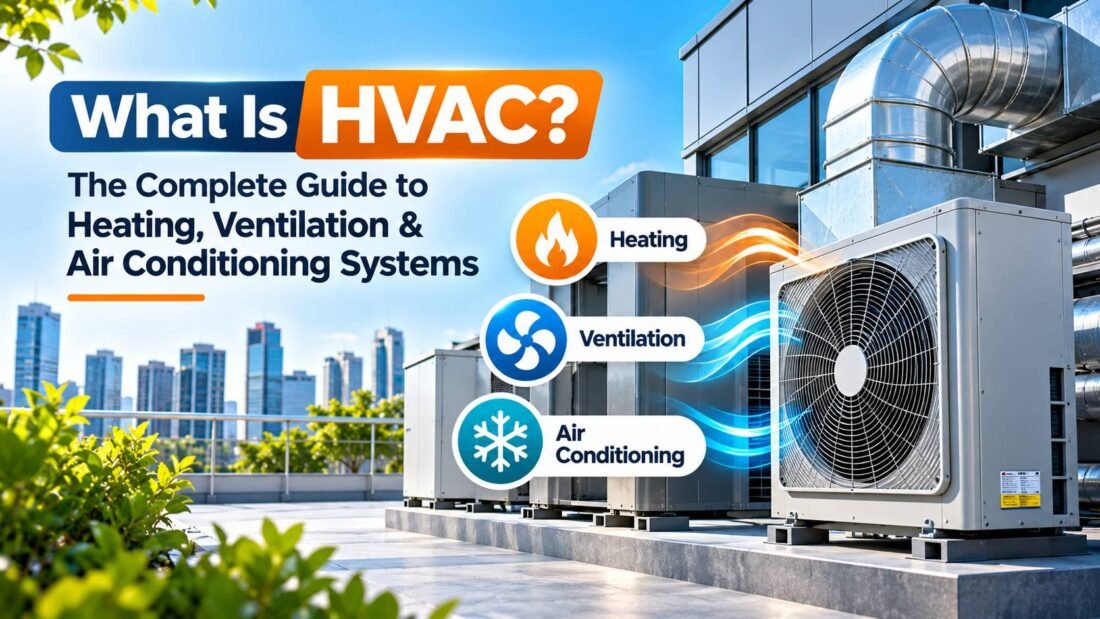
HVAC stands for heating, ventilation and air conditioning. It’s the equipment that keeps the air inside your home or office at a comfortable temperature, moves fresh air in and stale air out, and controls humidity. If your house has a furnace, a heat pump, an air conditioner or a network of vents in the ceiling or floor, you already own an HVAC system.
So what is HVAC in plain terms? It’s the comfort system of a building. Most people only think about it when something breaks. A July afternoon with warm air blowing from the vents will teach you more about HVAC than any textbook. But knowing the basics ahead of time helps you talk to contractors, spot problems early and avoid paying for things you don’t need.
What Does HVAC Stand For?
Each letter covers one job the system does:
- H for Heating. Warms the air in cold weather using a furnace, boiler or heat pump.
- V for Ventilation. Swaps indoor air with outdoor air and moves air around the building so it doesn’t get stuffy.
- AC for Air Conditioning. Removes heat and moisture from indoor air in hot weather.
You’ll also see HVACR, which adds refrigeration. That term shows up more in the trade, since the same technicians often work on walk in coolers, ice machines and grocery store cases.
What Does HVAC Mean in Everyday Use?
When a homeowner says “the HVAC is out,” they usually mean the whole heating and cooling setup, not one machine. When a contractor says “HVAC,” they’re often talking about the trade itself, as in “I’ve been in HVAC for 15 years.” And on a real estate listing, “new HVAC” usually means the furnace and air conditioner were replaced recently, which is a real selling point since that work can cost five figures.
What Is HVAC Worth to Your Wallet?
Heating and cooling is the single biggest energy expense in most homes. According to the U.S. Energy Information Administration, space heating and air conditioning together made up 52% of the average American household’s energy use in 2020. So when your system runs poorly, you feel it on your utility bill every single month.
Here’s a simple example. Say your household spends $2,400 a year on energy. If roughly half of that goes to heating and cooling, you’re spending about $1,200 a year just to stay comfortable. A system that runs 15% below its rated efficiency because of a clogged filter or leaky ducts could be costing you $180 a year for nothing.
What Is an HVAC System Made Of?
An HVAC system is a group of parts that work together. The exact setup varies, but most homes in the U.S. have some version of these:
| Component | Where It Sits | What It Does |
|---|---|---|
| Thermostat | Wall inside the home | Tells the system when to turn on and off |
| Furnace | Basement, attic, closet or garage | Burns gas or uses electric coils to heat air |
| Air handler or blower | Inside, often with the furnace | Pushes air through the ducts |
| Evaporator coil | On top of the furnace or in the air handler | Absorbs heat from indoor air during cooling |
| Condenser unit | Outside on a concrete pad | Releases heat from inside to the outdoors |
| Refrigerant lines | Between indoor coil and outdoor unit | Carry refrigerant back and forth |
| Ductwork | Walls, attic, crawlspace or basement | Delivers air to rooms and returns it |
| Air filter | Return vent or next to the blower | Traps dust, pet hair and pollen |
| Vents and registers | Floors, walls and ceilings | Where air enters and leaves each room |
The Thermostat
Think of the thermostat as the boss. It reads the room temperature and sends a signal to the equipment when it’s time to run. A basic manual thermostat costs around $25. A smart thermostat that learns your schedule runs $100 to $250.
The Furnace or Heat Source
Most homes in colder states use a gas furnace. Homes in the South often use a heat pump, which moves heat instead of creating it. Some older homes in the Northeast use a boiler, which heats water and sends it through radiators or baseboard pipes.
The Ductwork
Ducts are the highways your conditioned air travels on. They’re also where a lot of energy disappears. ENERGY STAR estimates that in a typical house, about 20 to 30 percent of the air moving through the duct system is lost to leaks, holes and poor connections. That’s air you paid to heat or cool, leaking into an attic or crawlspace.
How Does an HVAC System Work?
The process is simpler than it looks. Here’s what happens on a hot afternoon when your thermostat is set to 74°F and the house hits 76°F:
- The thermostat senses the temperature is above the setting and signals the system to start.
- The outdoor condenser fan and compressor turn on.
- The indoor blower pulls warm air from your rooms through the return vents and filter.
- That air passes over the cold evaporator coil, which absorbs its heat and pulls moisture out of it.
- The cooled air gets pushed back through the ducts and out of the supply vents.
- Refrigerant carries the heat it picked up outside, where the condenser releases it.
- Once the house reaches 74°F, the thermostat shuts everything off.
Heating works the same way in reverse for a heat pump. With a gas furnace, a burner heats a metal heat exchanger, and the blower pushes air across it to warm your home.
What Does HVAC Do Besides Heating and Cooling?
A well designed system does a lot more than change the temperature:
- Controls humidity. Air conditioners naturally remove moisture. In humid places like Houston or Atlanta, that matters as much as cooling.
- Filters the air. A good filter catches dust, pet dander and pollen before it circulates again.
- Brings in fresh air. Newer, tighter homes often use an energy recovery ventilator to swap stale indoor air for fresh outdoor air.
- Keeps you safe. A properly maintained furnace vents combustion gases outside instead of into your living space.
Common Types of HVAC Systems
| System Type | How It Works | Best For | Typical Installed Cost |
|---|---|---|---|
| Split system (AC + furnace) | Outdoor condenser with indoor furnace and coil | Most U.S. homes with ducts | $8,000 to $15,000 |
| Heat pump split system | One outdoor unit heats and cools | Mild to moderate climates | $7,000 to $16,000 |
| Ductless mini split | Outdoor unit connected to wall mounted indoor heads | Additions, older homes without ducts | $3,000 to $5,000 per zone |
| Packaged unit | All parts in one cabinet outside or on the roof | Homes without indoor space, many commercial buildings | $6,000 to $12,000 |
| Boiler with radiators | Heats water that flows to radiators | Older homes in cold climates | $6,000 to $13,000 |
| Geothermal heat pump | Uses stable ground temperature | Long term owners with land | $18,000 to $35,000 |
Costs above are typical 2026 ranges for a standard size home and will vary with your region, home size and how much ductwork or electrical work is needed. Always get at least three written quotes.
Residential HVAC vs. Commercial HVAC
A house usually needs 2 to 5 tons of cooling. A mid size office building might need 50 tons or more, often from rooftop units or chillers. Commercial systems also handle much larger amounts of outdoor air because building codes require it for occupants. The basic science is the same, but commercial equipment is bigger, more complex and usually controlled by a building automation system rather than a single thermostat.
How Long Does an HVAC System Last?
With regular maintenance, most central air conditioners and heat pumps last 12 to 15 years. Gas furnaces often last 15 to 20 years. Ductwork can last 25 years or longer if it’s sealed well and not crushed. Skipping yearly tune ups shortens those numbers, sometimes by several years.
Signs Your HVAC System Needs Attention
- Some rooms are much warmer or colder than others
- Your energy bill jumps 20% or more compared with the same month last year
- You hear banging, grinding or squealing when the system starts
- The system turns on and off every few minutes
- There’s ice on the refrigerant lines or outdoor unit in summer
- You notice a burning or musty smell from the vents
Any one of these is worth a call to a licensed technician. If you smell gas or your carbon monoxide alarm goes off, leave the house first and call from outside.
Simple Things Every Homeowner Can Do
- Check your air filter every month and replace it when it looks gray.
- Keep at least 2 feet of clear space around the outdoor unit.
- Don’t close more than a couple of supply vents. It can strain the blower.
- Schedule a professional tune up once a year, cooling in spring and heating in fall.
- Set your thermostat a few degrees higher in summer and lower in winter when you’re away.
The Bottom Line
If someone asks you what is HVAC, the short answer is this: it’s the system that heats, cools and freshens the air in your home. It’s also the biggest slice of most energy bills and one of the most expensive things in a house to replace. Knowing what each part does makes you a smarter buyer, a better maintainer and a harder customer to upsell.
Frequently Asked Questions
What does HVAC stand for?
HVAC stands for heating, ventilation and air conditioning. Some people write HVACR, which adds refrigeration.
What is an HVAC system in a house?
It's the equipment that heats and cools your home, usually a furnace or heat pump, an outdoor AC unit, ductwork, vents and a thermostat.
Is HVAC the same as air conditioning?
No. Air conditioning is one part of HVAC. HVAC also includes heating and ventilation, so it covers the full year, not just summer.
Does every home have an HVAC system?
Most U.S. homes do, but not all. Some use only window units, space heaters or a wood stove, which are not full HVAC systems.
How much does a new HVAC system cost?
A typical central AC and furnace replacement costs about $8,000 to $15,000 in 2026, depending on home size, efficiency and local labor rates.
How often should an HVAC system be serviced?
Once a year at minimum. Many homeowners schedule cooling service in spring and heating service in fall for the best results.
